Agricultural and rural construction environments are highly diverse, ranging from flat dry farmlands and dense orchards to muddy wetlands, steep mountain slopes, and rugged small mining sites. Standard general-purpose farm vehicles often struggle to adapt to extreme terrain, variable load demands and complex working scenarios, resulting in low efficiency, frequent failures and short service life. In contrast, customized farm utility vehicles, with flexible personalized configurations and modular design, perfectly match diversified working conditions and have become the mainstream choice for modern agricultural and engineering transportation.
Custom Power Configurations Adapt to Variable Load and Terrain Intensity
Different working environments put forward completely different requirements for vehicle power output. For light daily operations such as orchard fruit transportation, grain hauling and rural daily material delivery, low-consumption single-cylinder water-cooled diesel engines with 25HP to 32HP can be customized, which achieves energy-saving and stable operation while meeting basic transportation needs.
For heavy-duty scenarios including mountain climbing, muddy road transportation, earthwork and muck haulage, users can upgrade to high-horsepower four-cylinder diesel engines. The customized power matching ensures sufficient low-speed torque, effectively avoiding power insufficiency and stalling when fully loaded on steep slopes and soft roads. This graded power customization solves the pain points of insufficient power for standard light vehicles and excessive fuel consumption of heavy models in light working scenarios.
Terrain-Specific Chassis & Tire Customization Improves Off-Road Adaptability
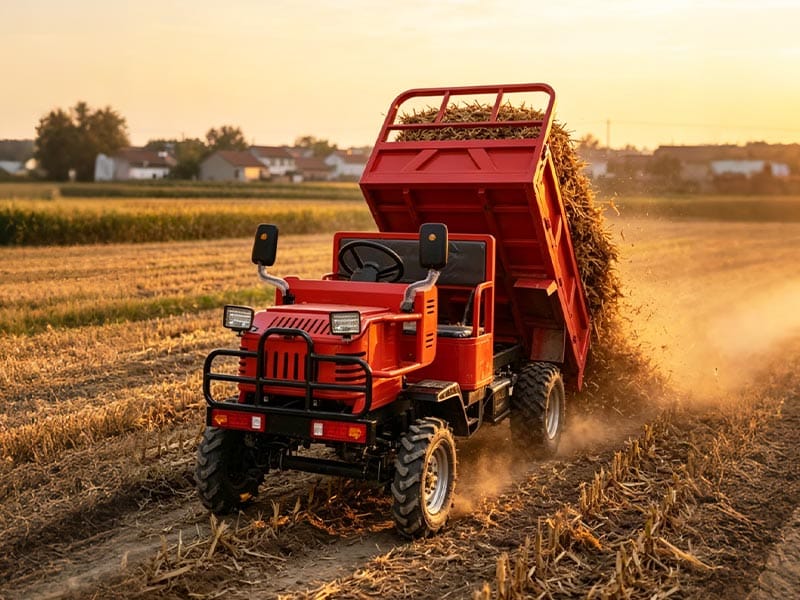
Terrain difference is the biggest challenge for farm transport operations. Customized utility vehicles support targeted chassis and walking system upgrades for different road conditions. For flat and hard rural cement roads, standard chassis and conventional tires can be configured to reduce vehicle weight and save fuel. For soft farmland, wet mud roads and rainy field operations, users can customize deep-tread anti-skid mountain tires and reinforced anti-sink chassis, which greatly enhances ground grip and prevents sinking and slipping.
In view of steep mountain roads and bumpy complex terrain, high-ground-clearance chassis and reinforced shock absorption systems are optional. The optimized chassis structure effectively avoids chassis scratching, while the upgraded suspension system ensures stable vehicle body operation, adapting to long-term bumpy off-road driving and greatly improving trafficability in harsh environments.
Modular Functional Customization Covers Diversified Operation Scenarios
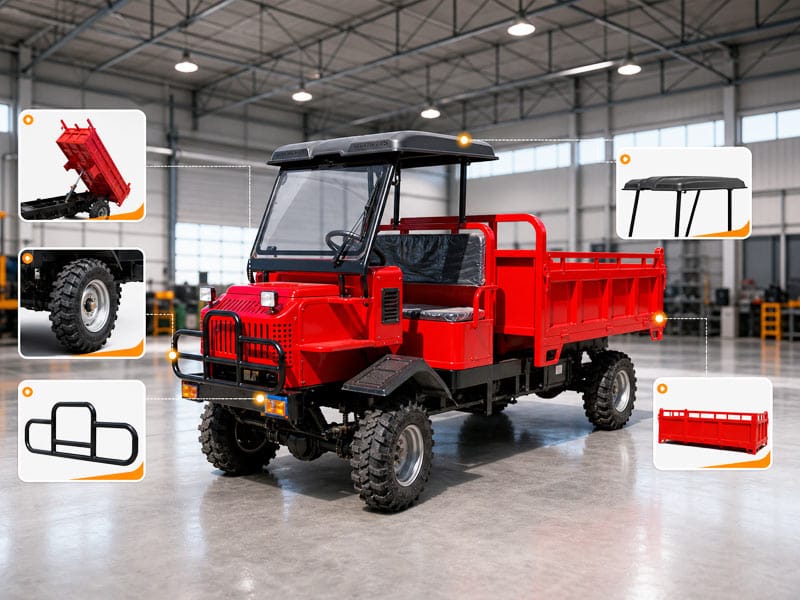
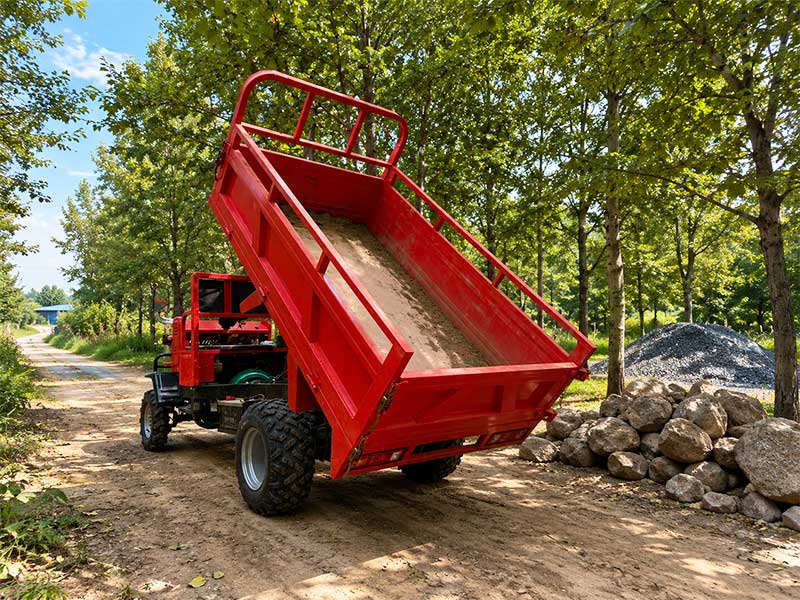
The core advantage of customized farm utility vehicles lies in modular functional expansion, which realizes scenario-based exclusive adaptation. For single agricultural planting scenarios, users can customize standard hydraulic self-unloading cargo boxes to meet the rapid transportation of grain, vegetables, fertilizers and other bulk materials.
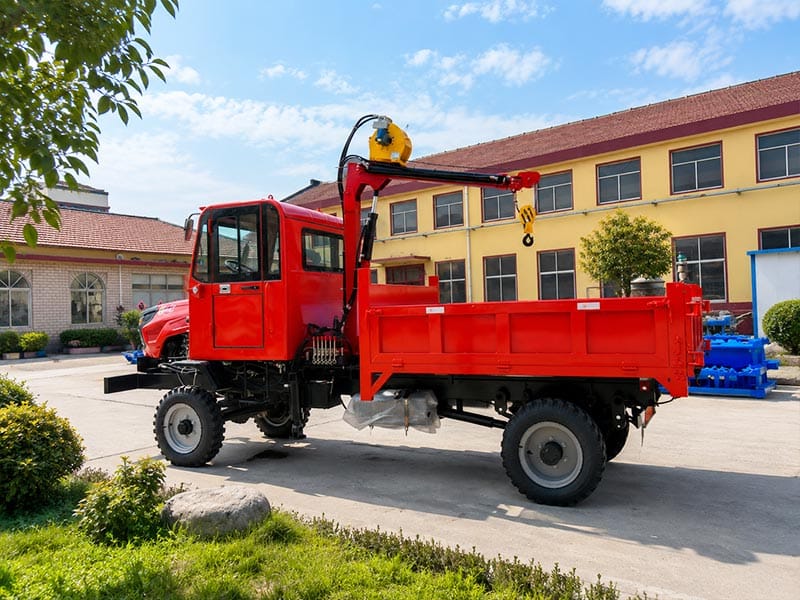
For multi-scenario mixed operations integrating agriculture, forestry and construction, the vehicle can be equipped with optional auxiliary devices such as log loaders, mini excavator brackets and truck-mounted cranes. In orchard operations, it can complete fruit picking and material transportation; in forestry operations, it can realize timber loading and hauling; in rural construction sites, it can undertake earthwork and muck transportation. The customizable functional modules enable a single vehicle to switch freely between multiple working scenarios, breaking the single-function limitation of traditional fixed-structure vehicles.
Brake & Driving System Customization Guarantees Environmental Operation Safety
Different working environments have distinct safety requirements for vehicle control systems. For flat and low-load farmland operations, vacuum-assisted hydraulic brakes can be customized, featuring sensitive braking and low maintenance cost, which meets the daily light-duty operation safety standards.
For high-risk scenarios such as mountain downhill roads, muddy steep slopes and heavy-load transportation, full air brake systems are optional, with stronger braking force and more stable braking performance, effectively avoiding braking failure caused by heavy loads and complex terrain. In terms of driving modes, the customizable 2WD/4WD switchable drive system allows free switching according to road conditions: 2WD for flat roads to save fuel, and 4WD for rough and muddy roads to enhance traction, balancing operational economy and terrain adaptability.
Humanized & Structural Customization Adapts to Regional Working Habits
In addition to core performance configurations, customized vehicles also support personalized upgrades for structural details and appearance according to regional working environments. Users can choose fully enclosed or semi-enclosed cabs according to seasonal climate, which is windproof, rainproof and dustproof, improving driving comfort in outdoor long-hour operations. Multiple body color options are available to meet on-site management and identification needs.
Meanwhile, the cargo box size and baffle height can be customized in a targeted manner according to local transportation materials and operation space. Narrow cargo box configurations adapt to narrow orchard passages, while enlarged cargo box structures meet the large-volume transportation demand of construction earthwork, realizing precise matching with actual working conditions.
Industry Summary
Standard farm vehicles can only adapt to single and conventional working scenarios, while customized farm utility vehicles rely on flexible personalized configurations to solve the adaptation problems of power, terrain, function and safety in complex environments. By tailoring power systems, walking structures, functional modules and safety configurations according to actual operation needs, the vehicles can maximize operational efficiency, reduce failure rates and adapt to all kinds of harsh and diverse working environments, becoming the most practical and cost-effective transportation equipment for modern agricultural production and rural engineering construction.